© 2008 -- 2011 the Grandpa at The Word Mechanic. All rights reserved.
Showing posts with label Maine. Show all posts

Monday, November 9, 2009

Learning as I Go: Part 2 -- Getting Started/Painting #2

Step 3 -- Paint the sky


I only have a slight understanding of the concept of underpainting. It's the first layer of color or colors that serve as the basic definition of the painting in progress. It "blocks in" the composition and serves as a blueprint for subsequent layers of color as details are added or refined. This first layer, according to some of the sources I looked at, should lay down the darkest color for the sky, water, and foreground and then the overpainting will add highlights, brightness, and variations in color.


I read about it, but I wasn't really conscious of "underpainting" as I began the canvas. Start with the sky and work forward was the basic principle my father had taught me. So that's what I thought I would do here. But acrylic is different from chalk or pastel or watercolor. So I wasn't going to be able to do what I thought I was going to do. I saw very quickly I was going to have to go back to the sky multiple times.


The horizon was an accident, albeit a happy one. I got too much dark blue on my brush as I was painting the lower portion of the sky. But I saw immediately that it worked for the deeper water of the background. So I actually ended up doing what was in my ead two steps at once. From there it was a simple step to block in the lighter water of the foreground. And since the sky was pretty much dry, I decided to try to lighten it up.


I was satisfied with that day's work, and I felt like I'd learned something.
To be continued...

Sunday, November 8, 2009

Learning as I Go: Part 1 -- First steps Painting 2

After I did my first acrylic painting [see it here], I read more about the importance of using natural light in the process of painting. It's essential for being able to see the actual colors I'm putting on canvas. So, since I didn't have room by the window in my office to set up the easel, and since I couldn't really count on having time during the day when the light was best to paint, I bought myself a daylight lamp to clamp onto my easel. It made all the difference.

I put the painting back on the easel, and the green and red paint I'd used to put grasses in the foreground and the blue grey gravel path popped. But the middle ground didn't. The surface of the hill extending down to the ocean was flat. It still is, but I intend to change it. First, though, I need to understand more about painting light--as well as the lack of light. So I've been reading about and studying samples of techniques such as "glazing," which I'll talk about in a future installment of Learning as I Go.

In the meantime I started a second painting. If you're interested, I want to share with you what it's like to be a complete novice teaching myself to paint.

Step 1: Choose the Scene
We went to some fascinating places this past summer in California and in New England, and I took a ton of photos. So I started the second painting by printing out a number of photos and spending a lot of time just going through them. I finally narrowed the choice down to two:

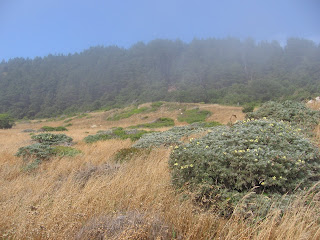
Choice 1 -- Hillside at Timber Cove where we stayed at the ocean in California


Choice 2 -- Lighthouse and Rocks off the coast of Maine at Fort McClary
(1)...........................................................................


(2)........................................................................


I liked the first choice because I liked the different textures and I want to learn about painting grasses and foliage. I also want to be able to paint a hillside head on and give the viewer the feel of the ground rising.

I liked the second because there was a lot of motion in the water and because the challenge of painting daylight above the blue of the water was intriguing.

I decided I wasn't ready yet for the challenges in the first picture, and learning how to paint light is probably my first real task. So I chose the second picture.

Step 2 --Draw It
I made several sketches. (If I can't draw it, I can't paint it.) Here is the last one I made.


Doesn't really have the detail or the perspective I think it should have, but I thought it was enough to get me started.

Step 3 -- Paint the sky

[to be continued]