© 2008 -- 2011 the Grandpa at The Word Mechanic. All rights reserved.
Showing posts with label craft. Show all posts

Thursday, February 4, 2010

The Writer's Wife

A week ago, I received my copy of the latest issue of The Raintown Review. In it is a poem called "The Writer's Wife." It's five pages, and it begins like this:

"For fifteen years we lived against the sea
Below Ogunquit where the surf marks time
And tide, and days remained unchanged, and each
Of us learned to watch the seasons silently.
He needed me. I cared for him. He wrote.
I listened when he read to help him find
A voice. But otherwise, we seldom spoke."
It is my most significant poem to date. And at five pages, it's also the longest poem I have ever published. I wrote the first version of the poem over 40 years ago. The idea came from a fantasy game my first wife and I played when were dating. It was about a woman who had thrown her childen off a cliff. The idea didn't gel as a poem, and although I kept writing it again and again throughout the years, I couldn't make it work.

Then about seven years ago while I was living in Birmingham, something happened on a trip to Maine that changed the whole concept of the poem for me. I knew the poem was not about a mother who murdered her kids. It is about what happened to a couple after their seven-year-old daughter was lost by being caught in a rip current, and it tells the story of the next 15 years of their life. Once I realized what the poem was really about,  it took me a couple of months to actually write it. And it wasn't easy. It's a formal poem with a difficult rhyme scheme. But once I started, once I wrote the line "For fifteen years we lived against the sea," I had no doubt where it was going or that I would complete it.

I finished the poem shortly before that Christmas. It's a funny thing about writing poetry. I know I've said this before. It's hard work to write a good poem. It's even frustrating work, and you have to love -- not the frustration -- but the work itself. And you have to simply know it's going to come together.Then when it does, you look at it and say, "Of course. This was where I was going all the time." And you immediately forget the work. It just feels natural, as if it always was that way.

I included the poem in a reading I did at Keuka College in Finger Lakes district of New York a few years ago. At the reception after the reading, the poet Bruce Bennett, who had been in the audience, came up to me on his way out and said he thought there was something epic about the poem. That was the greatest compliment he could have paid me. I spent nearly my entire adult life writing it. It feels good to have it recognized.

I can't post the poem here, because it's in the current issue of the magazine. And it's also not on line there. If you want to read it before my next book is done, you'll need to buy a copy of Volume 8 Issue 2 of The Raintown Review or else look back here on the blog in about six months. But since I can't post it, I'm going to repost a poem I first put up here last May. I only got one comment on it, so maybe you missed it. Or maybe you were just being polite.

From the Choir Loft

Singing is twice praying.

On alternating days we sang the Mass
At seven, boys, then girls, then boys again.
Sometimes the only ones who'd show
To sing were me and Hal the organist,
And I could barely hum a note. Refrains
Eluded me, so Hal would sing it solo.

Now Hal had music in his hands and feet;
The organ's pipes were a part of him.
But when he tried for music from his throat,
Well, Father said it sounded kind of sweet
If sweet meant scratchy, hoarse, and thin
And not unlike the bleating of a goat.

From Kyrie to Agnus Dei, Hal
Sang all the parts, sang treble, alto, bass
And never worried what the music said.
The words were all that mattered. Still somehow
He'd hit the final note then turn his face
And wink at me and proudly raise his head.

Hal quit the church when Kyrie became
The simple English Lord and anyone
Who wanted stood and strummed communal chords
For Masses where the singing was the same
As elevator sap, and Hal seemed stunned
To learn that music is in deed the words.

Originally published in Birmingham Poetry Review, Summer/Fall, 2005.
© copyright 2009 the Grandpa at The Word Mechanic Blog.
All rights reserved

Friday, January 8, 2010

Still Learning as I Go

My second painting is done, framed, and shipped to my sister-in-law for a Christmas gift. (In my family, we draw names and give a gift that we have to make to the family member whose name we get. My sister-in-law likes lighthouses, so the picture seemed appropriate.) I really meant to continue the Learning as I Go series of posts while I painted it. But given how little time I've spent on the blog over the last month or so, that proved hard to do.

That doesn't mean I didn't continue to learn. For one thing I learned how hard it is to paint daylight. The sky went through multiple paintings and over paintings.


I knew this first one wasn't right, but wasn't sure why. So I tried again.


I liked the water here, but the sky was just getting darker. After a couple of more attempts, I came up with this.

At first I was impressed with the clouds. But after a couple of days looking at it from my desk, they struck me as being unnaturally white, and the sky still wasn't any lighter. So I went back to the book I'd been reading and read again about glazing and also about working orange and yellow into the clouds to give the impression of daylight. So I painted this.


At this point, I was glad I had a career working with words and so decided not to quit my day job. But I took one more stab at it.


I really messed up the water, but, hey, the sky had light. I don't think the author of Genesis had any idea just how hard it is to let there be light. I know I didn't do it in a day.

Next, after working for several days to restore the water, came the rocks and then the light house.

The signature.


And finally the frame.


So what have I learned? I learned I really like doing this. And I think I learned something about painting daylight, which is what I had set out to do when I chose the lighthouse as my subject.
I've started a third picture. Now I'm learning how to paint foliage and grasses. If you don't mind I'll share some of that that experience with you too.
Happy New Year, everyone.

Sunday, November 8, 2009

Learning as I Go: Part 1 -- First steps Painting 2

After I did my first acrylic painting [see it here], I read more about the importance of using natural light in the process of painting. It's essential for being able to see the actual colors I'm putting on canvas. So, since I didn't have room by the window in my office to set up the easel, and since I couldn't really count on having time during the day when the light was best to paint, I bought myself a daylight lamp to clamp onto my easel. It made all the difference.

I put the painting back on the easel, and the green and red paint I'd used to put grasses in the foreground and the blue grey gravel path popped. But the middle ground didn't. The surface of the hill extending down to the ocean was flat. It still is, but I intend to change it. First, though, I need to understand more about painting light--as well as the lack of light. So I've been reading about and studying samples of techniques such as "glazing," which I'll talk about in a future installment of Learning as I Go.

In the meantime I started a second painting. If you're interested, I want to share with you what it's like to be a complete novice teaching myself to paint.

Step 1: Choose the Scene
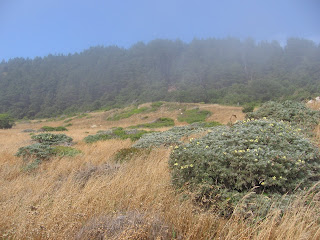
We went to some fascinating places this past summer in California and in New England, and I took a ton of photos. So I started the second painting by printing out a number of photos and spending a lot of time just going through them. I finally narrowed the choice down to two:

Choice 1 -- Hillside at Timber Cove where we stayed at the ocean in California


Choice 2 -- Lighthouse and Rocks off the coast of Maine at Fort McClary
(1)...........................................................................


(2)........................................................................


I liked the first choice because I liked the different textures and I want to learn about painting grasses and foliage. I also want to be able to paint a hillside head on and give the viewer the feel of the ground rising.

I liked the second because there was a lot of motion in the water and because the challenge of painting daylight above the blue of the water was intriguing.

I decided I wasn't ready yet for the challenges in the first picture, and learning how to paint light is probably my first real task. So I chose the second picture.

Step 2 --Draw It
I made several sketches. (If I can't draw it, I can't paint it.) Here is the last one I made.


Doesn't really have the detail or the perspective I think it should have, but I thought it was enough to get me started.

Step 3 -- Paint the sky

[to be continued]

Saturday, August 29, 2009

Thinking about the reader

Here’s the “lead” paragraph from an article for the web I edited the other day:
For some expectant moms, even the slightest ache or pain can trigger a five-star alarm and trip to the doctor, but other pregnant women may well ignore a potentially serious warning sign because they think it is a normal part of pregnancy or they fear of being the girl who cried wolf.
This is from a professional writer with an impressive list of credits, including Woman’s World magazine, Arthritis Today, and the Wall Street Journal. The writer has a graduate degree in journalism, and has won awards for online reporting. I can only assume the writer was having a bad day. (Actually, what I really assumed is that the writer is used to having her work very heavily edited and simply doesn't care.)

That one-sentence paragraph has 52 words and a Flesch-Kincaid grade level of 21.7. And can someone please tell me what a five-star alarm is? I know there is a product called a FiveStar Alarm that can be used to detect levels of dangerous gasses. So the writer may have been trying to use a metaphor, but I don’t think it works. I didn’t know there was such a product until I googled it, and I doubt many readers would know either. But what I really wonder is why a writer for whom English is not a second language would turn in an article with the phrase “they fear of being the girl who cried wolf." All that tells me is the writer didn’t bother to read any of the text before turning it in.

S and I were having dinner a few weeks ago with some close friends who are professional communicators like us, and at one point in the discussion the issue was raised about whether or not every assignment was equally important. J, an editor whose work I especially admire, said, “No, some assignments don’t matter. The job is just to get them out there.” Her point was that if an editor or a reporter treated every piece he or she is working on as if it needed to be perfect, the pieces that did truly matter might never get done.

I tend to agree with J. But that’s because I understand she wasn’t saying that there was any excuse for shoddy craftsmanship from a professional. And it doesn’t excuse a professional communicator for not considering the audience. You put out the best you can in the time you have with the attention it deserves. But if it isn’t clear, if it isn’t accurate, if the language isn’t at least used properly, you don’t present it.

If the writer of the one-sentence paragraph had any concern at all for the readers or for the subject matter, the paragraph might have looked like this:

For some expectant moms, the slightest ache or pain triggers a major alarm and a trip to the doctor’s office. But other pregnant women sometimes ignore a potentially serious warning sign. They may think it’s a normal part of pregnancy. Or they may simply not want to be seen as the girl who cried wolf.

Friday, July 3, 2009

Notes on Getting Published

(1) I once sent a group of poems to the Amherst Review. I waited a year to get a response. Finally, almost one year to the day after I sent them, I got a letter saying they wanted to publish one of the poems. I sent them the writer's info and waited again. One year later the issue with my poem was published.

They had left out a word.

(2) The only sure way to get published is to outlast the rejection slips.

(3) The times they are a changin.

Typically, when you send a poem to a literary journal, you can expect to wait anywhere from 6 weeks to 6 months to get a response. Ideally you can use that time to get your mind off the work you just sent out and turn to other work that needs to be completed and sent out. Then when the to-be-expected rejection letter comes, it's no big deal, because you've already moved on to other things that have assumed greater priority. That let's you get reacquainted with the work that came back. You can look at it objectively and analyze it to determine whether you need to trash it, revise it, or simply find a better match to send it to.

But now we use the Internet to submit our work. Some journals still take three months to decide to tell you no. But one day last week, I got a rejection email 12 hours after I had sent the poems.

Thursday, July 2, 2009

Problem/Solution

I know I haven't posted much about the agonies of editing recently. Wait. Come to think of it I haven't posted much of anything recently. Hmmmm. Well, anyway, as I was saying, I got this gem of a sentence today in an article about feeding an adult dog.

An adult dog's diet can contain up to 50% carbohydrates, including 2.5% to 4.5% fiber, according to the National Research Council, a scientific research unit of the nonprofit National Academies.

So...
.............. let's take a look at that sentence. First of all, it's 30 words. Now 30 words is a long sentence in an article aimed at an audience whose reading skills are defined as basic. The company I'm doing this work for defines basic as high school level. But that may actually be a little high for the general lay audience of adult readers they are trying to reach. When I edit or write for them, I shoot for an eighth grade reading level. (Which has nothing to do with the level of the intelligence of the audience. It only involves the ease with which the audience can take the information in.) The reason I aim for an 8th grade level is that a 6th grade level, which is more accurate, takes more time than they want to pay me for.

But this isn't really about reading level (or how much I get paid). It's about putting information in a sentence the audience can use. Now when we take a look at the sentence, it seems there's some important information in there. How do I know? Because there's a really impressive source being cited. Come on, we all know about the "National Research Council, a scientific research unit of the nonprofit National Academies," don't we?

PROBLEM # 1: Who says this (or "says what," because by the time I get to the end of the sentence I've forgotten what I was being told)? And why am I supposed to believe them? Their name sounds impressive. But who the hell are they? I just formed a group here in Atlanta where the CDC is located. We call ourselves the National Citizen's Healthcare Oversight Committee. Now we're probably going to be able to convince a lot of people about what we say. Why? Because we're right here where the CDC is.

Actually, my group is going to be more successful. Everybody has heard of the CDC. Well, not everybody, but enough. Can I have a show of hands. How many of you out there know what the "National Academies" are, or is it is?

Solution #1: Actually, I happen to know a little bit about both the National Academies and the National Research Council. But I'd have to Google them to be able to tell you who they are and what they do. And there was a paucity of hands raised just a moment ago.

So the first thing to ask as an editor is does the writer explain anywhere in the article who or what these agencies are? No. As a matter of fact, that is the only time their names appear in the article. So the solution seems easy. If you are going to call on an authority to vouch for your claim, then you need to make sure your readers know who that authority is. So the first option is to tell them.

But, no. That's a problem because it's going to take up a lot more space than it warrants and that's going to take the reader farther away from the real point of the article: What kind of dog food should I buy for my dog? (As I type this, Yeats is staring up at me with a hungry look in her eye. But then, she's still a puppy. Puppies are supposed to be hungry.)

The second thing I ask as an editor is do we really need the attribution. The answer is no. This is not a scientific paper for a peer reviewed journal. The website where this article will appear has a major reputation as an authoritative source. And underlying that is a rigorous fact checking and medical review process. Plus they hire good editors who are going to check these things out, even before the article gets to those stages. So we drop the attribution and come up with this:

An adult dog's diet can contain up to 50% carbohydrates, including 2.5% to 4.5% fiber.

Now that's much better. The message is clear with nothing about the National Academies to get in the way. It works because the website and the parent company have believability.

And look at that. I've actually solved two problems. I've cut the sentence in half. It's now just 15 words. A manageable chunk of information.

Problem #2: Yes there is a problem number 2. How do you calculate and confirm those percentages when you buy dog food. And I'll tell you that elsewhere in the article the writer pointed out that coming up with this information is hard because you can't rely on the label. And right. The writer didn't tell the reader how to determine the necessary percentages. Oh, me. An editor's work is never done.

Solution #2: Ignore the problem. Let the readers do some research of their own. You of course know that's not the correct answer. The correct answer is to send the article back to the writer and ask for more information. Taking the attribution out was an editor's call. Explaining how to figure the percentages is a writer's job.

Unfortunately, I didn't send it back. I didn't have time, and this article is part of a major launch, which is scheduled to happen very soon. My decision to let the article go as is was based on the fact that there was enough information in the article to make it useful and interesting and that it was an important part of the launch and needed to get into review. That was step 1 in figuring out a solution. Step 2 was realizing there really isn't enough time to make the article complete. It needs to go into review.

I would never knowingly make that kind of decision with an article that would involve injury. But now you know how articles that are less than perfect end up in print or on the web.

Sunday, June 28, 2009

Harvard Square

At Au Bon Pain the old men sit around
a table, scratch their noses, and contemplate
the fate of kings and queens then demonstrate
their prowess with a calculated frown.

A young musician plays her violin.
Her notes compete with phrases in the air
and foreign words that jostle through the square
like cups and napkins blowing in the wind.

Beside a tree a great dane lies untended,
doesn’t move for a boy with purple hair,
doesn’t mind a woman lost in prayer,
keeps its head down until, its vigil ended,
it rises when its master says, “Come on.”
Old men in baggy pants exchange their pawns.

Originally published in A Matter of Mind, Foothills Publishing, 2004.
© copyright 2004, 2009 the Grandpa at The Word Mechanic Blog.
All rights reserved.


I had a conversation with an artist named Kashley yesterday. He was alone in a gallery in Roswell, Georgia. He had told the owners of the gallery, both of whom had other commitments, that he would mind the gallery for them since he was going to come in and paint there that day anyway. He has a series of limited edition still lifes that are all about cocktails, and he likes to display the original next to the reproduction so that people can see that the reproductions are not digitally enhanced. So he had an original there, and he was painting a new picture.

The pictures are extremely detailed. They include vodka bottles or whiskey bottles. A liquid being poured into a glass. Glass ashtrays. Cocktail glasses with olives in them. I'd seen the work before, and what I admire about it the most is the way he works with the transparency of the glass, the way the light plays through it and then through the liquid, and the way he handles the texture of the surfaces that can be seen through the glass--a table, or a wall, or a fireplace.

It takes him three months to complete one of the paintings. The process begins with staging the still life and taking hundred of pictures of it. Then he takes a month to complete the first rough painting, which he then goes back to and paints over, filling in detail and pulling out color and light. This second painting takes another month. He then repeats the process again, adding more detail and removing brush strokes.

He also does abstracts which grow out of the textures and colors he finds in nature. He's been painting professionally, he told me, since 2006, and he currently has work in galleries in three different states. You can see some of his work on his Web site here, but it's much more impressive when you can see the actual work in front of you.

I enjoy the paintings, and I enjoyed the conversation with him. And I enjoyed watching him work. I have no other reason for telling you about him than that.

Saturday, June 20, 2009

Moonlight

One thing I never shared with you
..........was the moon outside my window
..........when I was a child in August
..........with a chill in the summer air.
It was so clear and white
..........that late at night
..........it had to be closer than it really was.

Published in A Matter of Mind, Foothills Publishing, 2004.
© copyright 2004, 2009 the Grandpa at The Word Mechanic Blog.
All rights reserved.

Some thoughts about other things

My father was an artist. He used to tell me that anyone could draw. Although, he did manage to let me know that he didn't think I did a very good job at it. He also wasn't very enthusiastic about my poetry when I was a teenager.
My youngest brother and my second son got his talent.

I did enter art work in the fair when I was a kid. I got my share of ribbons. But I never felt like I really understood what my father did when he painted, or worked with clay, or did pieces in enamel.

As a teenager, I liked to work with chalk and also oil pastels. I liked the feel of using my fingers to blend the colors in a sky and on a lake.

I drew pictures once in a while, mainly sketches and doodles, after I became an adult. But I didn't get serious about it again -- and I'm really stretching it to say serious -- until we moved to New Jersey in 2000. Then I started working with watercolors. They were crude, but S liked them and started buying me more paints, pencils, sketch pads. And I kept it up after we moved to Birmingham, Alabama, a year and a half later. I did more pencil sketches than anything. I like to draw.

Two years later we moved back up to Massachusetts, and I lost the incentive. So the art activity (and the photography I'd been getting more and more into) dropped way off. Now that we live in Atlanta, I'm interested in doing more art.

When I was young, I never thought my father was very successful at teaching me to draw, which was strange because for years he taught art to kids in his home on Saturdays, and a number of them went on eventually to study art and take it up as a career. But now when I do pick up a drawing pencil, I can hear him standing behind me telling me I wasn't doing something right and know that I did, after all, learn something.

If you haven't visited Rene at Not the Rockefellers, you should. I feel like I learn something about writing when I read her blog. And I really like her mission statement: "To inspire and encourage others to write freely." It's followed by a wonderful quote from Martha Graham. Check it out at the top of the left hand sidebar.


Sunday, May 17, 2009

More on poetry

Kringle from A Poetic Journey Through Life left a comment on my post about free verse and traditional form and asked to hear my thoughts about what she said. Here's what she said:
I found your post interesting... though I am no expert, I have done a fair amount of studying on the role of poetry and journal writing (I call it personal writing), in the development of the self. In my research I have found there are many reasons persons write... and yet too some of the poetic musings you discuss are related to semantics and syntax. Yet too, for many, poetry is merely an exploration and expression of self that leads to a transcendent place. Common themes I have found are the personal exploration and creation of selfhood through the personal writing. So perhaps part of all of this relates to the writer, the skill, and the purpose by which it is written? I'd appreciate your thoughts..

I think the points she makes are really good. Having taught writing for more than 20 years before becoming a full-time freelancer and having continued over the years by developing new writers as an editor and teaching as an adjunct faculty member, I'm well aware of the role writing plays in self discovery and development. And as a poet, I know the power of exploring poetic expression. One way we create and discover new knowledge is through metaphor, and metaphor is at the very heart of poetic expression.

I know that many people use poetry to both "explore" and "express" self. And there is a very long history and strong tradition of poetry being used in multiple settings as a form of therapy. And whether someone uses poetry as a form of private journaling or in a more formal therapeutic way, there is nothing "mere" (in the sense of limiting or simple) about the act. And anything that helps us achieve some level of transcendence is certainly outside the critical arena I intended that earlier post enter.

But we need to make distinctions. Poetry written as part of a therapeutic program and the lines and metaphors that you and I and millions of other people all over the world scribble into our journals at the end of a day or while sitting with a cup of tea in a coffee shop is not the same as poetry printed or posted on line in literary journals and zines or as poetry in even more mainstream publications. Poems in journals and poems that come out of a course of treatment are private poems. They are not and should not be subject to the same rules and expectations that poems presented as art are subject to. That doesn't mean that poems written in journals and written as therapy can't also be artistic and good. Some are excellent examples of the poetic art. But poems written for publication and for an audience are by definition an art form and can be expected to do certain things. There is a tradition they belong to. There is an ancient history of poetry as art and a history of theory just as ancient. Somehow the poems that are presented as art must carve out their place within that tradition or fall by the wayside. Those were the poems and that was the poetry I was referring to last Monday.

Tuesday, May 12, 2009

Some thoughts about free verse and traditional form

I've looked at a number of "literary journal" web sites over the last few days reading "sample poems" that reveal the editors' taste. I have to tell you I'm not overly impressed with a lot of what I see. And here is some of my thinking.

First of all, poetry should be something more than prose, or at least something different. And new poetry should do something more than old poetry, or at least something different.

Taking bad prose and breaking it into lines that make it resemble a poem doesn't change the fact that it's still bad prose.

Free verse is not prose broken into lines. Good free verse has structure of some sort and rhythm of some sort.

Free verse means verse that is genuinely "free" to explore language in interesting ways. It should use language in a way that prose doesn't and in a way that traditional form doesn't. It should explore new syntax.

Formal verse and free verse share the same grammar but not the same syntax. But some poets approach free verse as syntax without grammar.

Unless free verse genuinely explores the nature of rhythm of both language and image, it is a lazy approach to writing poetry.

When a person encounters a poem--either through writing it or reading it--that person should ask and attempt to answer -- what is exciting about the poem's language? what is exciting about the way the words are working together?

Friday, May 8, 2009

Thoughts on Being a Freelancer Supplemental

Writer and Editor

A couple of week ago, I said a writer is "someone who knows words and knows language and gets turned on by using both well (and by seeing other people do the same thing). A writer is someone who is curious about a lot of different things, and knows ways to satisfy that curiosity--how to research, who to ask, and what to ask in order to get the right information to share with readers."

An editor is a lot like a writer but different. While a writer's passion is words, an editor's passion is text. A writer uses words for a lot of different reasons--to convey information, to explore ideas, to persuade, to incite, to define the world the writer inhabits, to create meaning. Text is what results from the effort to do those things. But text usually is not an end in itself.

An editor understands there's a special relationship between text and its intended audience. Text without readers, that is text that exists outside a community, has no power. It can't inform. It can't incite. It can define nothing. (Just an aside here. A writer can also be the sole audience for what is written.)

The editor is like a bridge between writer and reader. The editor's first task is to make the effort to understand exactly what the writer is saying and what the writer is trying to do by saying it. And the second task is just as important. The editor needs to understand how the audience is going to respond to the text and whether or not that response is going to be the one the writer wants. Then it becomes the editor's job to bring the two things -- the writer's intent and the audience's response -- as close together as possible.

The jobs are different. But one quality identifies both -- a passion for language, including a passion for using it well. It's no surprise that the best writers and the best editors often do both tasks very well.

Tuesday, May 5, 2009

Open Journal

I appreciated the comments that some of you left on yesterday's post. And I have to agree that I like the images and generally like the feel of the lines. But I don't think there's enough there yet to call it a poem. There are some possibilities but no way to bring them to life. That means the sentiments remain private--between the speaker and his/her love. In that equation, there's no room (or there's too much room) for the reader. And there's no way in to the poet's vision.

The thrust of this fragment is toward a statement on art and passion. But the lines have no context. And without context, as plesant as they might be, they become cliche. The poet needs to push them beyond that to make them push -- or invite -- the reader to participate in the making of meaning. [Music is the purest art form (or perhaps it's dance), and poetry is the art of meaning.]

So where does that leave me as the poet. Sometimes changing one or two words can make all the difference. It didn't tonight. My sense is this IS a fragment. It's a part of something bigger. And I have a sense of a good poem coming on.

Thursday, April 30, 2009

Well this feels different

This morning, I finished the last piece of work in front of me that had a deadline. From 10 AM on, I have been unemployed. This is the first time since 1998 that I have not had at least one contract job still waiting on my desk to be done. I'm not worried. I have money coming in and there will be other work. It's just a strange feeling. It's also an opportunity. I can use the time to focus on doing more of my own creative work.

Tuesday, April 28, 2009

Billy, Age 44

“Is it true about Billy?” someone asked me this morning.
That was the first I’d heard about it.

If I’d looked hard enough
I might have seen the dying
that is the end
of summer,

the grass burning brown,
caterpillars spreading tents
in the tops of trees

and the horn worm clasped
to its leafless stalk while wasp
larvae nurse its sides.

All this time without
a sound, like night storms passing
north, silent flashes

through the calm chirps of crickets.

Originally published in Columbus Dispatch, May, 1982.
© copyright 2004, 2009 the Grandpa at The Word Mechanic Blog.
All rights reserved.

[Note: This is one of those poems that took several years to write. It's about a co-worker who committed suicide after taking a week off from work to get all of his affairs in order, including transferring the house to his mother's name and all the money in his bank account into his mother's account. The impetus for the poem came from a realization I had when I heard of his death that I'd seen the moment he had made the decision. There were just the two of us in the front of the store. It was close to closing time and we were both standing at the front counter filling out orders we'd taken over the phone. I looked over at him just as he looked up from the order form and stared out the front window. The look on his face was calm and resolved. He finished up the day's orders, said goodbye and left. That was the last time I or anyone else at the store ever saw him. So I wrote the poem about Billy's suicide multiple times. Sometimes I went into the history of his time in Korea or other times I wrote about the death of his father or about how Billy lived alone with his mother. He was an avid bowler so there was an attempt to write about bowling. I'd get the poem out again and again, revise, put it back the way it was, toss it out and start over. Then one late summer afternoon, I was sitting on my back porch watching a storm gather in the west and feeling a cooling breeze, and there was this poem in front of me. I think I took all of five minutes to get it down on paper, and I knew this was the Billy poem I had been trying to write for years. It was later published along with quotes from an interview I had given in a poetry column in the Columbus Dispatch. The topic of that week's column was the creative process.]

Friday, April 24, 2009

Thoughts on being a freelancer, lesson two

Last week's commentary on becoming a full time freelancer was about setting reasonable expectations at the start. This week I want to talk about a piece of advice every aspiring writer hears at one point or another.


So, Lesson Number Two in How to Become a Full Time Freelancer: What do you know--not that it's really all that important.


One of the most common piece of advice beginning writers hear is write what you know. To some extent, that makes sense. After all, if the closest you ever came to understanding a particle accelerator is watching coins disappear down a spiral coin wishing well funnel,


you may find it tough to explain what happens inside the Large Hadron Collider. (And what all the fuss was about -- Some kind of fear that black holes would suck up our world and everything in it from the inside out.)


But why would you try? Well let's see. My first writing paycheck was for $35 from United Way for an article I did for them on the Arthritis Foundation to use in their annual campaign. It had something to do with new treatments and helping people learn about them so they could make informed, competent decisions. My second pay check was also for $35, again from United Way, for an article about a program from the Diabetes Association to help people understand the importance of controlling blood sugar levels.

I had been a political science major before dropping out of college and going into restaurant work. I knew nothing about health care or medicine or managing chronic diseases. But the editor liked the pieces and I had my first professional credits. The key is, I did know something. I knew how to find out what I needed to know, and I knew how to ask questions and listen to the answers; so I could interview people and get the information I needed to write the piece the editor had asked for. In a sense, I did write what I knew. I knew how to learn and I wrote what I had learned.

Now there's all kinds of caveats attached to that. Notice, I wasn't writing for an audience of doctors. And I wasn't writing patient education pamphlets. I've done both those things multiple times throughout my career, but there was no way I could learn enough in a short period of time when I first started out.

So there are really two lessons to learn here. The first is that a would be writer cannot be handcuffed to the admonition to write only what you know. If that's all you do, you'll have a very small niche in the writing world indeed. And will you become a writer? Probably not. You'll be a barista who writes articles about double mocha lattes. Or a rocket scientist who knows how to make space travel interesting to audiences who read your occasional articles in Discover. But you'll always be a writer second.

A writer is someone who knows words and knows language and gets turned on by using both well (and by seeing other people do the same thing). A writer is someone who is curious about a lot of different things, and knows ways to satisfy that curiosity--how to research, who to ask, and what to ask in order to get the right information to share with readers.

That's not to say a writer doesn't specialize. For the last 13 or 14 years, I've made a good living writing about and editing works on health and health care for both health professionals and health consumers. And even though articles about health was what I got paid for when I first started, this one time college drop out glorified waiter and bartender wrote articles about beekeeping, running public parks, building a career as ceramic engineer, opening a general store, how books are bought for the library, subversive curriculum, literacy, writing a collaborative novel.

My first article in a national publication was about crepes. Even though I had worked in restaurants, I had never done anything with crepes (except for crepe suzette). But I was curious, and I created 20 crepe recipes. I even took pictures of the dishes and got paid for the photos. It wasn't that long after the Arthritis Foundation piece. And it made me feel really good about what I could do.

Now the second big caveat (the first was don't let yourself be limited by what you know) is know your limitations. For those of you who are still with me, lesson three will be The Great Hotel Fiasco--Don't bite off more than you can chew. (I'll tell you about my first real failure.)

Wednesday, April 22, 2009

Process

I sometimes wonder how anything becomes a poem. It frustrates me. And sometimes I feel certain that whatever I did in the past to transform a few random groupings of words collected from God knows where into poetry I'll never do again.

For the last couple of days, I've been looking over a series of notes I made a few years after my father died. They're about his art and about his need to tell stories that defined who he was. They're about how the stories became more important as he got closer to death. And they're about not listening to them and forgetting them. They're about watching football with him eight months before he died. And they're about the nothingness we come from, are born into, and move toward.

Some of the notes are broken up into lines, as if they were originally meant to be a poem. And as I read the notes, I can hear and feel the poem that's there. But I can't make it happen. It frustates me. But it's what I do.

Friday, April 17, 2009

Thoughts on being a freelancer, lesson one

A long time ago when I was reliable, meaning when I could be counted on to post regularly, and when people left comments, a few readers asked me to blog about my writing career. Truth be told, it's not that interesting. I write and I edit because I like working with words and meaning and ideas, and I like getting ideas across to other people. I'm also good at it. Plus, I don't know what else to do. Everything else seems boring.

[Well that's not exactly true. What's boring is reporting to someone else and letting that someone else dictate how I spend my time. If I'm going to screw up, if I'm going to miss out on life, I want it to be my fault. I don't want it to be because I didn't have any choice but to do what I was told. And there are a lot of other things that are not boring. I miss being an English teacher. I miss running college writing centers. I miss sharing ideas about how people learn with other professionals. And I really miss helping students realize what they're after. I also like to draw and play the piano. I'm not very good at those things, but I like doing them. And I like punching the speed bag. (There was a time in my life when I wasn't bad at that.) And if I could figure out how to make money doing any of those things, I'd give it serious thought. But I digress.]

Next, several people have asked me for advice on becoming a freelancer, and it occurred to me that I could do both, talk about my history as a writer/editor while talking about what it takes for one person to do it.

So, Lesson Number One in How to Become a Full-Time Freelancer: Don't Quit Your Day Job.

In 2006, there were 305,909 people making money as a writer or an editor. That really isn't a very large percentage of the working force. 197, 495 (or 65%) of them were "employed." That means they weren't working for themselves. 108, 413 (or 35%) were classified by the Bureau of Labor Statistics as self-employed or unpaid. For 80,000 of those workers, writing or editing was classified as their primary job. And for 28,000, writing or editing was a secondary job.

Now there are several important things to note in the above paragraph. The first is, given the amount of writing that gets done every day, there aren't that many writers and editors who are working, comparatively speaking.

The second thing is that the overwhelming majority of those who are working are working for someone else. They are not self employed. They are not their own boss. They are not masters of their own time. If you want to write or edit and get paid, your best bet is to find a job where that's part of the job description. There are a number of sites on the Internet where those kinds of jobs are listed. Google writing jobs. You'll find them.

The third thing to notice is what I bolded in the paragraph above. BLS labels self-employed writers and editors as potentially unpaid. There are a lot of people out there who will publish what you write and pay you by sending you a copy. There are even some, who will make you pay for the copy. Other people will pay you by the word--often starting around 2 cents. And I know things have changed since I started, and you can write stuff and post it on site on the Web at a site that will pay you based on how many page clicks you get. Well, call your family. Call your friends. Tell them to click through. Tell them to tell their friends to click through. And then wait.............

The unfortunate thing about that is if you don't have a network (meaning connections), and you don't have a track record (meaning publications), you actually have to write for those people [two cents a word/pay by click]. It's the only way to build a publications list. You need that to get jobs.

So when I was in my 20s, I read everything I could about making a living as a writer. I went to college, dropped out, went back, dropped out again, went back ad nauseum. Finally, I dropped out and went to work in the hospitality industry. I was the youngest maitre d' in the history of Brookside Country Club. And I was damn good. But there was one thing that was consistent. I never stopped reading Writer's Digest. [That is not an endorsement. In fact, for those who are serious about wanting to write for a living, I'd recommend not reading it.] And I focused on the things that would make me an instant success. I settled on syndication. That was the way to go. You write something. You send it to a syndicate. They sell it and split the money with you. It's easy living.

So I was a young husband and father. We traveled. [ha!] We went from Columbus to St. Louis. I talked to people in whatever job I had. So I came up with an idea called From Here to There. The idea was I wrote these little essays about the people I met or the sights I saw. And then the syndicate would sell them. We'd be rich. We'd use the money to go somewhere else besides St Louis and write about it. It would be a wonderful life. I sent it off to syndicates. I got rejected over and over again.

That's not the way it works. [To syndicate, you get get your work published in several different local venues. Then you gather data to show that readers are reading it and responding. Then, maybe a syndicate will be interested. The real way it works is the syndicate finds you.] My approach, though, did work for some people (the ones who wrote the articles for writer's digest). For the vast majority of us who were clueless, it was just one more indication that we were not cut out to be writers.

We like to think of ourselves as Ernest Hemingway or Joan Didion. The truth is most of us are Joe the electrician [the plumber was a false identity] or Rosie the riveter. The Romance of writing catches our attention. The labor of writing somehow never peaks over the horizon. Writing, for the vast majority of us who make our living this way, is hard work. And it's work the uninitiated are never told about. Unless you have a track record, you are not going to make it as a full time freelancer. [There are always exceptions.] So keep that "day" job. Or better still, make that "day" job a writing job.

Enough about you. Let's talk about me. I had publications as a kid. Still, aside from a couple of prizes, I really didn't get paid for anything I wrote until I was in my mid twenties [maybe I'll talk about what happened when I first got paid in lesson two]. I didn't go out on my own to become a full time freelancer until I was in my late forties. I didn't feel comfortable at it until I was in my early fifties. But then again, I'm not all that comfortable right now, and I'm a long way past my early fifties. Still, I make a living. I have money coming in. And I have jobs in hand and jobs on the horizon.

For those of you who are still with me, the next lesson (lesson two) may be called "What Do You Know--But It's Not the Only Thing That Matters." And I'll talk a little bit more about what happened when I got my first paycheck.

Thursday, April 9, 2009

The trouble with freelancing

A lot of people who do what I did don’t last as long at it as I have. I officially stopped working for the man and became a full-time freelancer in May of 1994. That means I’m starting my 16th year in just a few weeks. I know when I tell people I make my living from writing and editing, it sounds Romantic, like I’m living the life of a knight-errant or, since I do get to write poetry, some type of medieval minstrel. The reality is it’s more like the life of a vagrant, just roaming here and there with no visible means of support and no real goal in mind.

A lot of people I know who made the same leap, do it for three or four years, but then they go back and take a job. That's because we're not making our living by writing the things we love--great poetry, amazing fiction, soaring new journalism essays that fill the pages of The New Yorker. It's a small percentage of writers who get to earn money that way. What most of us do is called contract writing or work for hire. We work for agencies, pharmaceutical companies, health plans. We write very specialized pieces aimed at computer geeks, investment bankers, physical therapists, or people with diabetes. Getting to set our own schedule means never taking a day off because if you don't work, you don't get paid. And if you don't have any work in front of you at the moment, you have to scramble to find a client and pick up another assignment.

After a few years of doing that, of living in a constant state of uncertainty about where your next pay check is coming from, a job with paid sick time and vacation, with a 401K and office colleagues to talk to during the day seems mighty appealing. Even if your client list is pretty secure, it's that not having people to talk to during the day that can get very oppressive. I have, over the past fifteen years, gone back to teaching part time on occasion, not because I needed the money, but because I just needed the human contact.

I had perhaps my best financial first quarter since I started freelancing this year. I was busy. stretched completely to my limits. I was working so many weekends I'd have trouble knowing exactly what day it was. Things are finally quieting down and I can breathe a little easier. Except...

The end of March. Did you hear that crashing sound? That was the roof of my security shelter crashing down around me. Two long-term contracts that formed a solid monthly income base just ended. Just like that. Boston Globe Media decided not to continue publishing a magazine that I had been managing editing for them for 11 years. Not only did I feel I was getting laid off, but I had to contact the writers who wrote regularly for me and tell them I'd have no more work for them in the foreseeable future. Then right after I got that word I found out the newsletter for health care providers I had been writing for the past five or so years was not going to be published anymore, and the publishing company that did them was closing.

That's the the way business I'm in goes. I'll get more work. It's just that right now I'm feeling a little wistful for the job security of a tenured faculty member that I left to follow my dream. On the bright side, I am going to have more time to get back to the blog. I've missed it.

Tuesday, March 31, 2009

Observations

Writing is the hardest thing I do. It's unfortunate that it's how I make my living.

On a more positive note. Tomorrow starts National Poetry Month. Check Mommy's Nintendo's challenge at The Itsy Bitsy Monkey. Even if you don't take her up on it, it's well worth watching her do it. I followed her last year through the whole month and quite frankly was amazed.

Tuesday, February 17, 2009

Way To Go Braja!

Check the spotlight (over in the right sidebar). It's a really good piece of news.